September 2, 2026
35.99%. That’s the maximum APR you might run into with certain installment loans in this state, specifically through programs like…
You’re standing in your kitchen, staring at a countertop that looks like it was designed by someone who hates granite, and you realize the sink is leaking just enough to keep you awake at night. You have a vision for a modern, open-concept layout, but your savings account is currently doing a very convincing impression of a flatlining heart monitor. This is where the dream of a renovation hits the cold, hard reality of liquidity.
Most people assume fixing a house requires a massive windfall or a second mortgage. They think they have to wait for the market to peak or for an eccentric aunt to leave them an inheritance. But there are ways to bridge that gap, specifically through loans designed to get a contractor off your lawn before they start charging you daily.
I see people trip over these decisions constantly. They either dive into high-interest debt or they wait three years while their HVAC unit slowly dies in the background. There is a middle ground, but you have to know which tool you’re picking up.
When we talk about home improvement loans, we’re mostly talking about unsecured personal loans. These are the most common tools for the job. You walk in, tell the lender what you need, and they give you the cash. The catch? They aren’t putting a lien on your roof.
Because these loans are unsecured, you aren’t putting your house up as collateral. This is different from a home equity loan or a home equity line of credit (HELOC), which can put your property at risk if you default. This lack of collateral is a double-edged sword. It makes the application process faster and keeps your house safe, but it also means the lender is going to look at your credit score with a microscope.
If your credit is mediocre, the interest rates will reflect that. You aren’t just paying for the new hardwood floors; you’re paying for the risk the bank is taking by trusting your word. Still, for many, the trade-off is worth it to avoid the headache of equity-based products.
The main reason people choose unsecured personal loans is speed. If your roof is shedding shingles like a molting bird, you don’t have three months to wait for an appraisal and a title search. You need the money now.
Many modern lenders can approve a request and deposit funds into your account within a few business days. This liquidity is the main driver for the personal loan market. You aren’t just borrowing money; you’re buying time.
A common misconception is that you can only use these funds for specific, “approved” renovations. In reality, a personal loan for home improvement is quite flexible. You can use it to fix a leaking pipe, replace a furnace, or even just upgrade your kitchen cabinets.
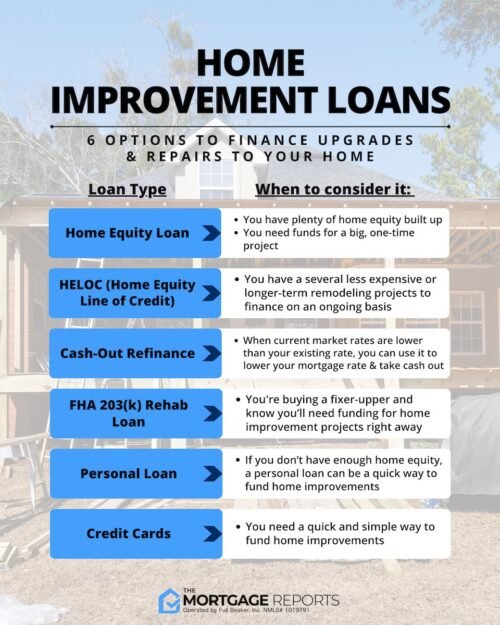
Not all debt is created equal. Picking the wrong one can turn a kitchen remodel into a decade-long financial anchor. You have three main paths: personal loans, credit cards, and home equity. Each has a specific purpose depending on your risk tolerance and your credit standing.
Personal loans offer fixed rates and fixed terms. You know exactly how much you will pay every month until the balance is zero. This is great for budgeting. Credit cards, on the other hand, are terrible for long-term renovations. The interest rates are usually higher, and if you only pay the minimum, you might still be paying for that new dishwasher in 2035.
| Financing Type | Collateral Required | Typical Speed | Best Use Case |
|---|---|---|---|
| Unsecured Personal Loan | None | Fast (Days) | Mid-sized projects/Repairs |
| HELOC | Your Home | Slow (Weeks) | Large, long-term renovations |
| Home Equity Loan | Your Home | Slow (Weeks) | Large, lump-sum projects |
| Credit Card | None | Instant | Small repairs/Emergency fixes |
But before you jump into any of these, look at the actual terms. A low interest rate is meaningless if the lender hits you with massive origination fees or prepayment penalties. I’ve seen people get lured in by a “low” APR, only to realize they are paying 5% of the loan amount just to get the money in the first place.
If you want more specific guidance on navigating these choices, checking out texasloanstoday.com can provide a localized perspective on how these rates and options play out in real markets.
It is easy to get caught up in the excitement of a new floor plan, but the math doesn’t care about your aesthetic preferences. When you take out a loan, you’re essentially borrowing from your future self. If you borrow $30,000 for a master suite at a 12% interest rate over five years, you aren’t just paying $30,000. You’re paying significantly more once the interest compounds.
Homeowners often forget about the “other” costs. It isn’t just the loan. It’s the permit fees, the unexpected rot behind the drywall, and the fact that the contractor you hired decided the project was going to take twice as long as quoted.
Scope creep is the silent killer of renovation budgets. You start with a plan to replace the linoleum in the laundry room. Suddenly, you realize the subfloor is shot. Then you decide it’s a good time to install a new washing machine with smart-home connectivity. Suddenly, your $2,000 loan is a $5,000 problem.
This is why a personal loan is often better than a credit card. A credit card has a revolving balance that can spiral out of control. A personal loan has a hard ceiling. You know exactly where that ceiling is, which forces you to be more disciplined with your contractor.
In a high-inflation environment, the cost of materials like lumber or copper can fluctuate wildly. If you take a loan today to start a project in six months, you might find that the money you borrowed no longer covers the actual cost of the goods. Always build a buffer into your loan amount. If you think you need $15,000, ask for $18,000. It is better to have extra cash in your savings than to be halfway through a renovation with an empty bank account and a hole in your ceiling.
The application process can feel like an interrogation if you aren’t prepared. Lenders are going to look at your debt-to-income ratio (DTI) with extreme scrutiny. They want to know if you can handle another monthly payment on top of your mortgage, car note, and student loans.
To get the best terms, treat this like a business transaction. This means having your last two years of tax returns, your most recent pay stubs, and a clear idea of exactly how much you need. Don’t guess. Guessing is how people end up with more debt than they can manage.
And don’t forget to look at the total cost of the loan, not just the monthly payment. A lower monthly payment over a longer term sounds nice while you’re sitting on your new deck, but it is a very expensive way to buy a view.
One real-world example involved a homeowner, let’s call him Dave, who wanted to fix his deck. Dave went with a low-interest, 10-year term because the monthly payment was only $150. He felt like a genius. However, after three years, he realized he had paid nearly $2,500 in interest alone on a project that only cost $8,000. He could have finished the whole thing in 24 months with a slightly higher payment and saved a thousand dollars.
You might be thinking, “What if the project doesn’t add value to the house?” That’s a fair question. If you’re putting $50,000 into a house in a neighborhood where the ceiling is $200,000, you might not see that money back in a sale. But home improvement isn’t always about ROI; sometimes it’s just about the fact that you can’t live in a house with a broken furnace. If the repair is essential, the ROI is simply avoiding a catastrophe.